
Amped Plumbing Blog · Water Quality
How to Choose a Water Softener for an Oklahoma City Home
Step 1: test the water
You need two numbers: hardness, measured in grains per gallon, and iron, if you are on a well. Without them, any size recommendation is a guess.
Step 2: size it
Multiply the people in the house by their daily water use (about 75 gallons each is a common planning figure), then by the hardness in grains per gallon. That is the hardness the softener must remove each day. A softener is sized to go several days between regenerations at that rate.
- Too small: it regenerates constantly, uses more salt and water, and runs out during heavy use.
- Too large: you pay for capacity you never use.
Step 3: features that matter
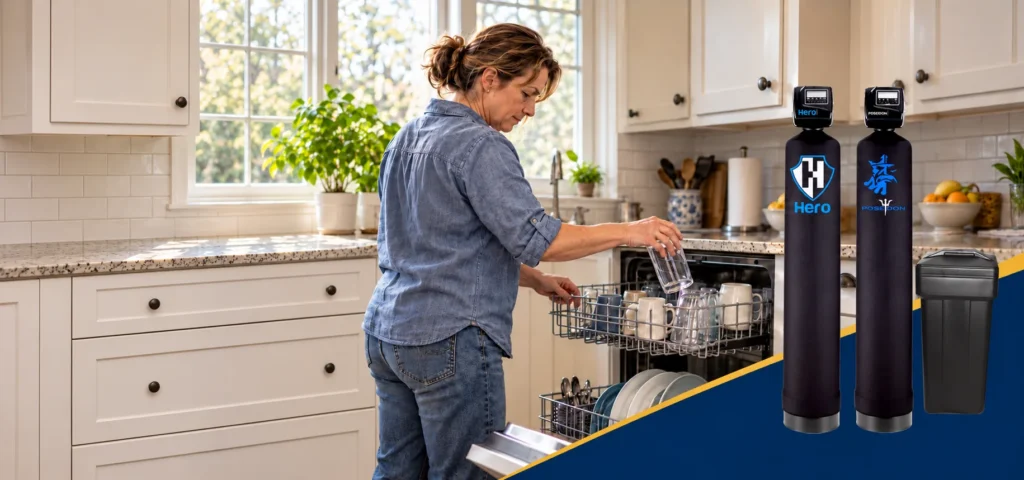
- Metered regeneration. It regenerates based on water actually used, not on a timer, which saves salt and water.
- A quality control valve. This is the part that does the work and the part that fails on cheap units.
- High-capacity resin suited to your hardness and any iron.
- A bypass valve so the softener can be taken offline without shutting off the house.
- Warranty and local service.
Salt-based or salt-free?
Salt-based softeners actually remove hardness minerals. They are the proven answer for hard water.
Salt-free conditioners do not remove the minerals. They are meant to reduce how much scale sticks. Results vary, and they do not give the soft-water feel or stop spotting. For Oklahoma City hardness levels, a salt-based softener is the dependable choice.
Where it goes
- On the main line, before the water heater.
- Near a drain for the regeneration water and a power outlet.
- Somewhere that does not freeze.
- Outdoor faucets are usually left on unsoftened water.
Questions to ask before you buy
- Did you test my water, and what were the numbers?
- How did you size this unit?
- Is it metered?
- Who services it, and what does the warranty cover?
- Is installation, including the drain and bypass, included?
How softeners work and the upkeep involved are in the complete guide to water softeners. For what we install and current offers, see water softener installation.
Amped Plumbing tests your water, sizes the softener to your household and installs it.
Common questions
What size water softener do I need?
It depends on your water hardness and household water use. A water test and a count of people in the home give the numbers needed to size it.
Are salt-free water softeners effective?
They do not remove hardness minerals; they aim to reduce scale buildup. For hard water like Oklahoma City’s, a salt-based softener is the reliable choice.
Where should a water softener be installed?
On the main water line before the water heater, near a drain and a power outlet, in a spot that will not freeze.
Amped Plumbing is a licensed plumbing company (OK Plumbing Contractor License #049194, held by Mickey Lyons) based in Warr Acres and serving the Oklahoma City metro, including Edmond, Moore, Yukon, Norman, Bethany and Nichols Hills.