

Amped Plumbing Blog · Water Quality
Water Softeners in Oklahoma City: The Complete Guide
How a water softener works
A softener is a tank filled with small resin beads. As hard water passes through, the beads grab the calcium and magnesium and release a small amount of sodium in exchange. This is called ion exchange.
When the beads are full, the softener cleans itself. It flushes them with salt water from a second tank (the brine tank), sends the minerals down the drain, and starts over. This is called regeneration, and it usually runs at night.
Do you need one?
You probably do if you see several of these:
- White scale on faucets and shower heads.
- Spots on dishes and glasses.
- Soap scum on tubs and shower doors.
- Dry skin and stiff laundry.
- A water heater that rumbles, or one that failed early.
- Water pressure that has dropped over the years.
A hardness test settles it. We cover what hard water does to plumbing in Does Oklahoma City have hard water?
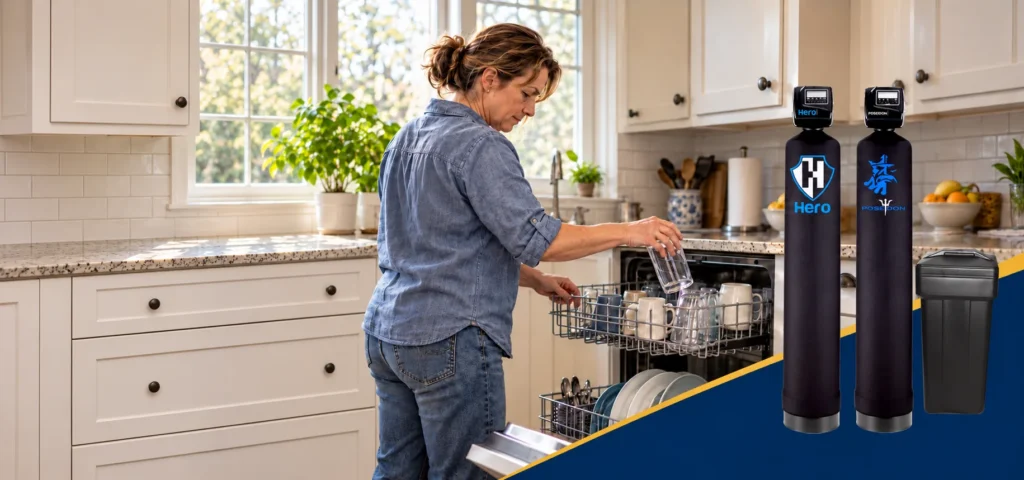
City water or well water
City water in the Oklahoma City metro is treated and safe, but it is hard. A softener handles that.
Well water is often harder and can also carry iron, which leaves orange or brown stains and can foul a softener. A well should be tested for both hardness and iron. Homes with iron usually need iron filtration ahead of, or in place of, a standard softener.
Amped Plumbing installs softening systems and iron-filtration systems, and matches the equipment to the test results. See water softener installation.
Choosing the right size
Softeners are sized by how many grains of hardness they can remove between regenerations. Two things decide the size:
- How hard the water is, from the test.
- How much water the household uses, which follows the number of people and bathrooms.
Too small and it regenerates constantly, wasting salt and water. Too large and you pay for capacity you do not use. This is the main reason to have the water tested before buying.
Upkeep
- Add salt to the brine tank when it gets low, usually every month or two.
- Check for a salt bridge: a hard crust that forms above the water so the salt stops dissolving. Break it up with a broom handle.
- Clean the brine tank about once a year.
- Watch for signs it has stopped working: spots and scale coming back, or soap that stops lathering.
Common concerns
Sodium. Softened water has a little more sodium than hard water. For most people the amount is small, but anyone on a sodium-restricted diet should ask their doctor, and can keep one unsoftened tap for drinking.
Slippery feel. Softened water feels slick in the shower. That is soap rinsing off properly, without the film hard water leaves.
Outdoor faucets. These are usually left on hard water, since softened water is not needed for the lawn.
Amped Plumbing tests your water and installs softeners and iron filtration across the Oklahoma City metro.
Common questions
Do I need a water softener in Oklahoma City?
Most homes benefit from one, because Oklahoma City water is hard. If you see scale on fixtures, spots on dishes and soap scum, a softener will reduce them and protect your water heater and plumbing.
How long does a water softener last?
A well-maintained softener commonly lasts 10 to 15 years. Keeping salt in the brine tank and cleaning it yearly helps it reach that age.
Will a water softener remove iron from well water?
A standard softener removes small amounts, but iron can foul the resin. Well water with noticeable iron usually needs a dedicated iron-filtration system.
Amped Plumbing is a licensed plumbing company (OK Plumbing Contractor License #049194, held by Mickey Lyons) based in Warr Acres and serving the Oklahoma City metro, including Edmond, Moore, Yukon, Norman, Bethany and Nichols Hills.